
QR Code Doorbell: Smarter Than Wired
A qr code doorbell gives you visitor access without wiring, batteries or apps. See how it works, where it fits, and when it beats a smart bell.
By DoorVi Team
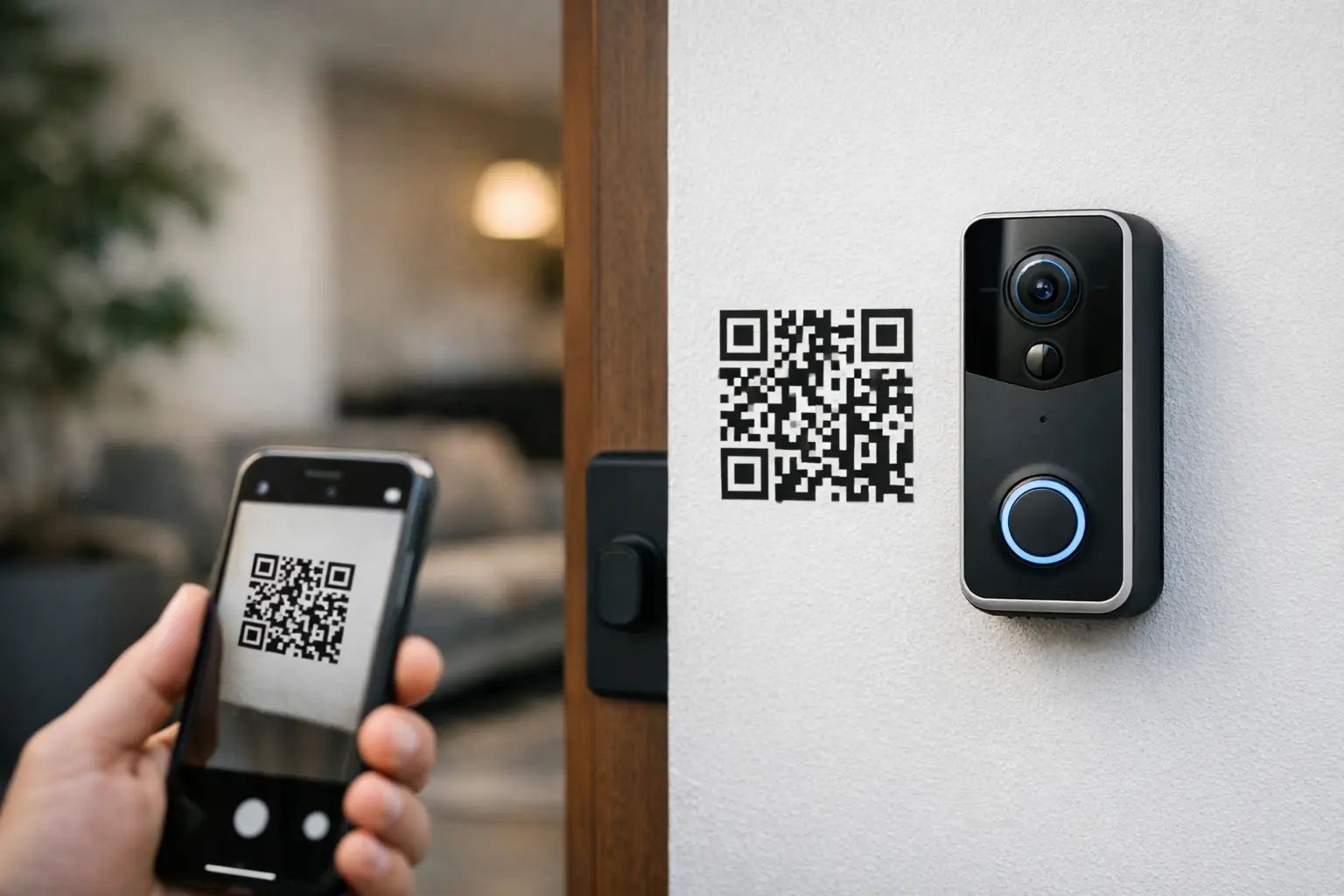
A missed delivery, a locked gate, a visitor at reception - most doorbell problems are not really about bells. They are about friction. A qr code doorbell cuts that friction down to almost nothing. Instead of wiring in a device, charging batteries, or asking visitors to install an app, it lets them scan a code or tap with their phone and start a secure video call in the browser.
That sounds simple because it is. The real question is whether simple is better. For many homes, flats, rental properties and small businesses, the answer is yes.
What a qr code doorbell actually does
A qr code doorbell replaces the usual press-button hardware with a printed or weather-resistant sign linked to a live contact point. When a visitor arrives, they scan the QR code with their phone camera or use NFC if their phone supports it. That action opens a browser-based call screen, and the occupant can answer remotely.
The key difference is that the visitor uses their own device. There is no camera unit mounted outside recording constantly, no battery powered chime to keep topped up, and no dedicated visitor app getting in the way. Scan. Call. Answer.
For the person inside, or away from the property, the experience is straightforward. You receive the incoming call, see the visitor, and speak to them. In privacy-first systems, your own image does not need to be shown back. That matters if you want to verify who is at the door without turning every interaction into a face-to-face video chat.
Why people are moving away from traditional smart doorbells
Most smart doorbells promise convenience, but they often bring a list of jobs with them. You may need wiring. If not, you are dealing with batteries. You may need a specific app, a stable Wi-Fi setup, a cloud account and, in many cases, an ongoing subscription if you want useful features.
That trade-off can make sense for some households. If you want continuous outdoor video capture and motion history, a camera-heavy system may still suit you. But many people do not need a surveillance device on the front wall. They just want a reliable way to know who is there and speak to them quickly.
That is where a qr code doorbell makes more sense. It removes installation barriers and strips the process back to the actual task - connecting visitor and occupant with as little effort as possible.
Where a qr code doorbell works best
This format is especially strong in places where conventional doorbells are awkward, expensive or simply unnecessary.
For renters, it solves a common problem. You may not be allowed to drill into exterior walls, alter wiring, or fit a permanent smart device. A code-based sign is easier to install and easier to remove when you move.
For homeowners, it offers a cleaner option at gates, side entrances, garden offices and detached buildings where wiring would be a nuisance. It also avoids another battery-powered gadget to manage.
For property managers, the value is even clearer. Shared entrances, blocks of flats, short-let properties and managed homes all suffer from access friction. Tenants change. Devices get neglected. Batteries die at the wrong moment. A simpler system is easier to deploy across multiple properties.
Small businesses and offices benefit too. Reception points, service entrances, studios and appointment-only spaces often do not need a full intercom install. They need a direct way for customers, couriers or visitors to announce themselves. A qr code doorbell gives them that without adding maintenance overhead.
QR code doorbell vs smart video doorbell
The comparison is not about which category sounds more advanced. It is about which one creates less friction for the job you need done.
A traditional smart video doorbell is usually better if you want passive monitoring. It can record motion, capture footage and behave more like a security camera. If your priority is keeping a visual log of everything happening outside, that matters.
A qr code doorbell is usually better if your priority is live visitor communication without hardware headaches. There is less to install, less to charge, less to troubleshoot and often less to pay for over time.
Privacy is another dividing line. Many people are increasingly uncomfortable with always-on cameras at home or work. A scan-to-call system is event-based. It activates when a visitor chooses to make contact. That is a very different model from constant recording.
There is one obvious trade-off. A QR-based system depends on the visitor having a smartphone and being willing to use it. In most urban and suburban settings, that is not a serious obstacle. For some older visitors, delivery drivers in a hurry, or locations with weak mobile signal, it may be less ideal unless NFC and clear on-site instructions are also available.
What to look for in a QR code doorbell
Not all systems in this category are equal. The best ones keep the promise of simplicity all the way through.
First, check that visitors do not need to download an app. App friction kills adoption. If the interaction works in a standard browser, more people will use it correctly on the first attempt.
Second, look at the hardware itself. A qr code doorbell should be weather-resistant, easy to mount and easy to read. If the sign fades, peels or looks confusing at the entrance, the whole system feels unreliable before the call has even started.
Third, consider privacy. A good setup should let you verify and speak to visitors without exposing more than necessary. One-way video can be a very practical choice because you can see who is there while staying off camera yourself.
Fourth, think about cost over time. The appeal of this format is not just lower effort on day one. It is also lower maintenance month after month. No batteries. No wiring. No subscription is not a slogan if it genuinely reduces ownership costs.
How installation changes the buying decision
This is where a lot of people change their mind.
A conventional smart doorbell often looks affordable until you add everything around it. Mounting hardware, electrician time, replacement batteries, optional chimes, cloud storage plans - the total cost can move quickly.
A qr code doorbell changes that equation because installation is closer to placing a sign than fitting a device. For many buyers, that is the real innovation. Not more features. Less effort.
That matters in everyday life. If you are managing one family home, simpler means you are more likely to set it up properly. If you are managing ten properties, simpler means rollout becomes realistic instead of turning into a project.
DoorVi is built around exactly that idea: make visitor access modern without adding hardware pain, app friction or recurring costs.
Is a qr code doorbell right for every entrance?
No. And that is worth saying plainly.
If you need constant footage for security review, licence plate capture, or wide-angle monitoring of a public-facing entrance, you may still want a camera-led system. A qr code doorbell is not trying to replace every security product.
But if the main job is answering the door, screening visitors and speaking to people from wherever you are, it is often the cleaner answer. That is particularly true for side gates, entrances to flats, office doors, managed rentals and other places where ease beats complexity.
The best choice depends on what problem you are actually trying to solve. If it is communication, not surveillance, a lighter system is usually the smarter one.
Why this shift matters
People are getting more selective about smart home tech. They are less impressed by feature lists and more interested in what keeps working with the least effort. Products that remove chores tend to win. Products that add another app, another battery and another bill do not.
That is why the qr code doorbell is more than a niche idea. It reflects a broader change in what buyers want from access technology: clarity, speed, privacy and control. Not complexity dressed up as innovation.
For homes and businesses alike, the best doorbell is not the one with the most hardware. It is the one that makes the front door easier to manage. If a visitor can scan, call and reach you in seconds, that is doing the job properly.